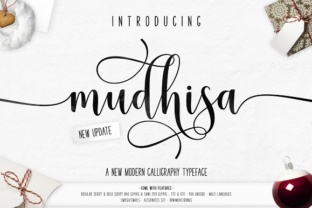
Mudhisa: A Modern Script with Four Distinct Styles
When you're working on a project that needs a personal, handwritten touch, finding the right script font can make all the difference. You want something that feels authentic, not like a generic computer script. You need a typeface that conveys warmth and personality without sacrificing legibility. This is where Mudhisa enters the conversation. It's a premium font family designed to offer that sought-after hand-lettered feel with the professional polish required for real-world applications.
Mudhisa is a stunning script font, but calling it just one font undersells its versatility. It actually comes as a family of four complementary styles: a flowing Script, a solid Bold, a clean Sans, and a dynamic Slant. This collection isn't just about having options; it's about providing a complete toolkit for creating cohesive and engaging designs. Each style maintains a consistent design language, ensuring they work together seamlessly, whether you're building a brand identity or crafting a single social media graphic.
Understanding the Mudhisa Font Family
Let's break down what you get with this creative font package. The core Mudhisa Script is the star—a fluid, connected typeface that mimics natural handwriting. It has elegant swashes and a rhythm that feels organic, making it perfect for logos, headlines, and any element where you want to draw the eye with a personal signature.
The Mudhisa Bold takes that same script character and gives it more visual weight. This is invaluable for creating emphasis. Use it for key words in a headline, a call-to-action on a website, or a product name on packaging where you need the script style to hold its own against other design elements. It maintains the handwritten charm while improving readability at smaller sizes or from a distance.
For balance and versatility, the family includes Mudhisa Sans. This is a clean, modern sans serif font that pairs beautifully with the script styles. It provides a stable, legible foundation for body text, longer descriptions, or supporting information. Using the Sans style for paragraphs ensures your content is easy to read, while the Script or Bold can handle the expressive headlines. This pairing is a classic strategy in modern typography for establishing a clear visual hierarchy.
Finally, the Mudhisa Slant offers a slightly italicized, forward-moving version of the script. It introduces a sense of motion and energy, which can be useful for dynamic layouts, quotes, or elements that need to feel less static than the standard script. Having these four styles—Script, Bold, Sans, and Slant—gives you a comprehensive design asset for a wide range of projects.
Where Mudhisa Truly Shines: Practical Applications
Knowing what a font looks like is one thing; knowing where to use it is where the real value lies. Mudhisa's personality makes it a strong candidate for projects that aim to feel approachable, artistic, or boutique. Think about the industries and contexts where a human touch is a competitive advantage.
For brand identity and logo design, Mudhisa Script or Bold can form the cornerstone of a logo for a boutique, a coffee shop, a florist, a wedding photographer, or a handmade goods store. It immediately communicates a level of care and artistry. Pairing the logo with the Mudhisa Sans for all other brand materials—from business cards to website navigation—creates a professional and consistent brand identity system.
In editorial and publishing design, this font family excels. A cookbook, a lifestyle magazine, or a blog can use the Script for chapter titles and pull quotes to add personality. The Bold can highlight ingredients or key tips, while the Sans handles the recipe instructions or article body text. This approach keeps the layout visually interesting and guides the reader's eye naturally.
Packaging design is another natural fit. Artisan products, cosmetics, and specialty foods often rely on shelf appeal that suggests quality and origin. Mudhisa's handwritten font style can make a product label feel authentic and crafted. The Slant might be perfect for a tagline or a descriptive phrase like "small batch" or "hand-poured."
Don't overlook digital and print marketing. For social media graphics, the Script or Bold can create eye-catching headlines that stop the scroll. Use the Sans for captions and details. In print, think wedding invitations, greeting cards, workshop flyers, or restaurant menus. The font's ability to be both decorative and functional makes it a practical choice for these high-impact, often short-form, pieces.
Making Mudhisa Work for Your Project: A Practical Guide
Choosing a font is a decision that affects how your audience perceives your work. Here’s how to evaluate if Mudhisa is the right typeface for your next project and how to use it effectively.
Evaluate the Project Fit. Start by asking: Does my project need a personal, expressive, or artisanal feel? Mudhisa works best when that handwritten quality is an asset. It might not be the ideal choice for a corporate financial report or a technical manual where a neutral, highly legible serif font or sans serif font is more appropriate. Its strength is in conveying personality.
Test Font Pairings. While the Mudhisa family is designed to work together, you might pair it with other fonts. A good rule is to contrast the expressive script with something more neutral. Mudhisa Script paired with a simple, geometric sans serif font for body text can look incredibly modern and clean. Avoid pairing it with another highly decorative typeface, as this can create visual chaos and hurt readability.
Consider Readability and Hierarchy. The Script and Slant styles are best used for headlines, logos, and short phrases. Their connected letterforms can become difficult to read in long sentences or small sizes. This is why including the Bold and Sans styles is so practical. Use the Sans for any text longer than a line or two. Use size, weight (Bold), and style (Script vs. Sans) to create a clear hierarchy that guides your reader from the most important information to the supporting details.
Review the Included Styles. Before you start, take inventory of the four versions. Plan how you'll use each. Perhaps the Script is for the main logo, the Bold for section headers, the Sans for all body copy and UI elements, and the Slant for accent quotes. Having this plan ensures you use the full potential of the asset and maintain design consistency.
Understand Commercial Licensing. If you're using Mudhisa for a client project, a product for sale, or commercial marketing materials, you must ensure you have the correct commercial font license. Most premium fonts, including quality script families, require a license for commercial use. Always check the terms provided with your font purchase. This is a standard part of professional design work and protects both you and the font creator.
Ultimately, Mudhisa offers a flexible and stylish solution for designers and creators who need to inject personality into their work without starting from scratch. Its four-version structure provides a ready-made system for building balanced, engaging, and professional designs across a multitude of mediums. By understanding its strengths and applying it thoughtfully, you can leverage this font to enhance your visual storytelling and connect with your audience on a more human level.